
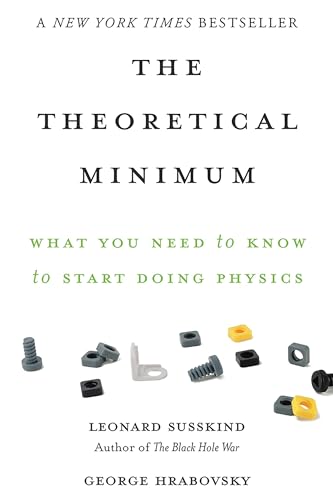
The theoretical minimum what you need to know to start doing physics
Material type: TextLanguage: English Publication details: New York : Basic Books, 2014Description: xi, 238 p. illISBN:
 - 9780465075683 (PB)
 BOOKS
List(s) this item appears in:
New Arrivals (01 October 2025)
BOOKS
List(s) this item appears in:
New Arrivals (01 October 2025)
| Home library | Call number | Materials specified | Status | Date due | Barcode | |
|---|---|---|---|---|---|---|
| IMSc Library | 53:001.92 SUS (Browse shelf(Opens below)) | Checked out | 09/04/2026 | 78810 |
Includes index.
The nature of classical physics -- Spaces, trigonometry, and vectors -- Motion -- Integral calculus -- Dynamics -- Partial differentiation -- Systems of more than one particle -- Energy -- The principle of least action -- Symmetries and conservation laws -- Hamiltonian mechanics and time-translation invariance -- The phase space fluid and the Gibbs-Liouville Theorem -- Poisson brackets, angular momentum, and symmetries -- Electric and magnetic forces -- Appendix 1. Central forces and planetary orbits.
A string theorist and a citizen scientist instruct lay readers on elementary principles of physics and associated math that amateur enthusiasts should know in order to study more advanced topics, in a reference that covers such topics as classical mechanics, electromagnetic fields and chaos theory--
"A first course in physics and associated math for the ardent amateur ... beginning with classical mechanics"--Dust jacket flap.
There are no comments on this title.