
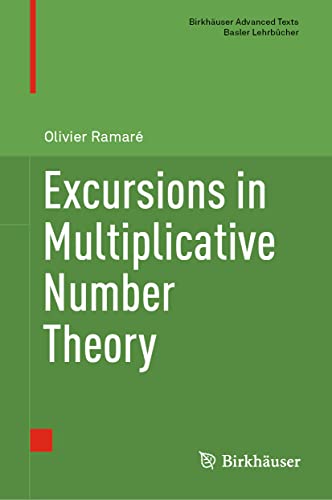
Excursions in Multiplicative Number Theory
Language: English Series: Birkhauser Advanced Texts Basler LehrbucherPublication details: Birkhauser 2022 ChamDescription: xxii, 338pISBN:- 9783030731687 (HB)
 BOOKS
List(s) this item appears in:
New Arrivals (01 June 2024)
|
New Arrivals (01 June, 2024)
BOOKS
List(s) this item appears in:
New Arrivals (01 June 2024)
|
New Arrivals (01 June, 2024)
| Home library | Call number | Materials specified | Status | Date due | Barcode | |
|---|---|---|---|---|---|---|
| IMSc Library | 511.33 RAM (Browse shelf(Opens below)) | Available | 77920 |
Includes Index
Includes bibliographical references
hapter 1: A Calculus on Arithmetical Functions
Chapter 2: Analytical Dirichlet Series
Chapter 3: Growth of Arithmetical Functions
Chapter 4: An "Algebraical" Multiplicative Function
Chapter 5: Möbius Inversions
Chapter 6: The Convolution Walk
Chapter 7: Handling a Smooth Factor
Chapter 8: The Convolution Method
Chapter 9: Euler Products and Euler Sums
Chapter 10: Some Practice
Chapter 11: The Hyperbola Principle
Chapter 12: The Levin-Fainleib Walk
Chapter 13: The Mertens Estimates
Chapter 14: The Levin-Fainleib Theorem
Chapter 15: Variations on a Theme of Chebyshev
Chapter 16: Primes in Progressions
Chapter 17: A Famous Constant
Chapter 18: Euler Products with Primes in Arithmetic Progressions
Chapter 19: Chinese Remainder and Multiplicativity
Chapter 20: The Mellin Walk
Chapter 21: The Riemann Zeta-Function
Chapter 22: The Mellin Transform
Chapter 23: Proof of Theorem ℓ
Chapter 24: Roughing Up: Removing a Smoothening
Chapter 25: Proving the Prime Number Theorem
Chapter 26: Higher Ground: Applications / Extensions
Chapter 27: The Selberg Formula
Chapter 28: Rankin's Trick and Brun's Sieve
Chapter 29: Three Arithmetical Exponential Sums
Chapter 30: Convolution Method / Möbius Function
Chapter 31: The Large Sieve Inequality
Chapter 32: Montgomery's Sieve
This textbook offers a unique exploration of analytic number theory that is focused on explicit and realistic numerical bounds. By giving precise proofs in simplified settings, the author strategically builds practical tools and insights for exploring the behavior of arithmetical functions. An active learning style is encouraged across nearly three hundred exercises, making this an indispensable resource for both students and instructors.
Designed to allow readers several different pathways to progress from basic notions to active areas of research, the book begins with a study of arithmetic functions and notions of arithmetical interest. From here, several guided “walks” invite readers to continue, offering explorations along three broad themes: the convolution method, the Levin–Faĭnleĭb theorem, and the Mellin transform. Having followed any one of the walks, readers will arrive at “higher ground”, where they will find opportunities for extensions and applications, such as the Selberg formula, Brun’s sieve, and the Large Sieve Inequality. Methodology is emphasized throughout, with frequent opportunities to explore numerically using computer algebra packages Pari/GP and Sage.
Excursions in Multiplicative Number Theory is ideal for graduate students and upper-level undergraduate students who are familiar with the fundamentals of analytic number theory. It will also appeal to researchers in mathematics and engineering interested in experimental techniques in this active area.
There are no comments on this title.