
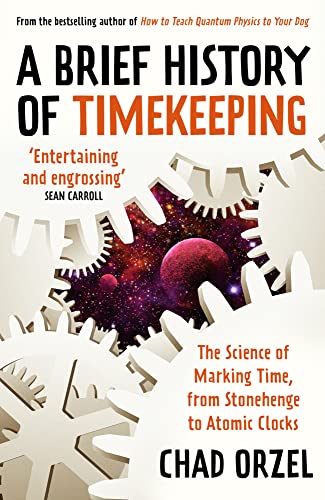
A brief history of timekeeping the science of marking time, from Stonehenge to Atomic Clocks
Language: English Publication details: Oneworld Publications 2022 LondonDescription: 324pISBN:- 9780861542154 (PB)
 BOOKS
List(s) this item appears in:
New Arrivals (14 July 2023)
BOOKS
List(s) this item appears in:
New Arrivals (14 July 2023)
| Home library | Call number | Materials specified | Status | Date due | Barcode | |
|---|---|---|---|---|---|---|
| IMSc Library | 930.1 ORZ (Browse shelf(Opens below)) | Available | 77113 |
You only need to press the snooze button on your alarm a bit too often to understand the importance of good timekeeping. What you might not know is that the need to tell the time connects you to over five thousand years of human history, from the first solstice markers at Newgrange to quartz crystal oscillating in your watch today. Science underpins time: from orbital motion and axial tilt to the quantum mechanics and relativity theory that gives us our ultra-precise atomic clocks. Yet time is also socially decided: the Gregorian calendar we use today is a result of complex political negotiations. The ancient Maya used sophisticated astronomical observations to produce a calendar system unlike any other in the world. In his quirky and accessible style, Chad Orzel reveals the wondrous physics that makes time something we can set, measure and know
There are no comments on this title.