
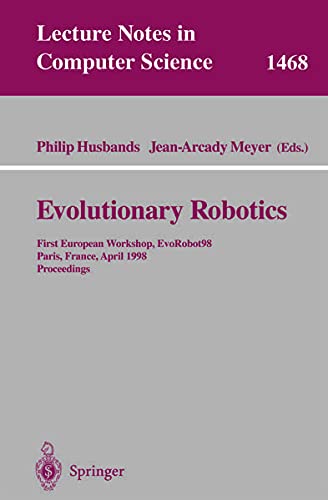
Evolutionary Robotics [electronic resource] : First European Workshop, EvoRobot98 Paris, France, April 16–17, 1998 Proceedings / edited by Philip Husbands, Jean-Arcady Meyer.
Material type: TextSeries: Lecture Notes in Computer Science ; 1468Publisher: Berlin, Heidelberg : Springer Berlin Heidelberg, 1998Description: VIII, 252 p. online resourceContent type:
 - text
- computer
- online resource
- 9783540499022
- 004.0151 23
- QA75.5-76.95
 E-BOOKS
| Home library | Call number | Materials specified | URL | Status | Date due | Barcode | |
|---|---|---|---|---|---|---|---|
| IMSc Library | Link to resource | Available | EBK6903 |
Evolutionary robotics: A survey of applications and problems -- How co-evolution can enhance the adaptive power of artificial evolution: Implications for evolutionary robotics -- Running across the reality gap: Octopod locomotion evolved in a minimal simulation -- Detour behavior in evolving robots: Are internal representations necessary? -- Evolving robot behaviours with diffusing gas networks -- Explaining the evolved: Homunculi, modules, and internal representation -- Some problems (and a few solutions) for open-ended evolutionary robotics -- Noise and the pursuit of complexity: A study in evolutionary robotics -- Hardware solutions for evolutionary robotics -- Blurred vision: Simulation-reality transfer of a visually guided robot -- Learning to move a robot with random morphology -- Learning behaviors for environmental modeling by genetic algorithm -- Evolving and breeding robots -- Off-line model-free and on-line model-based evolution for tracking navigation using evolvable hardware -- Incremental evolution of neural controllers for robust obstacle-avoidance in Khepera.
This book constitutes the thorougly refereed and revised post-workshop proceedings of the First European Workshop on Evolutionary Robotics, EvoRobot '98, held in Paris, France in April 1998. The 15 revised full papers presented outline the state of the art in this new interdisciplinary area of research and development. The introductory paper gives a survey of the use of evolutionary computing techniques for the automatic design of adaptive robots.
There are no comments on this title.