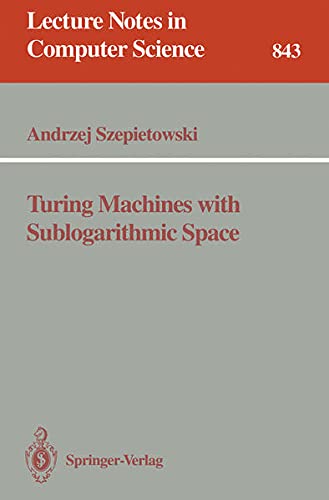
Turing Machines with Sublogarithmic Space [electronic resource] / edited by Andrzej Szepietowski.
Material type: TextSeries: Lecture Notes in Computer Science ; 843Publisher: Berlin, Heidelberg : Springer Berlin Heidelberg, 1994Description: VIII, 114 p. online resourceContent type:
 - text
- computer
- online resource
- 9783540486695
- 005.1015113 23
- QA76.9.L63
- QA76.5913
- QA76.63
 E-BOOKS
| Home library | Call number | Materials specified | URL | Status | Date due | Barcode | |
|---|---|---|---|---|---|---|---|
| IMSc Library | Link to resource | Available | EBK6545 |
Basic Notions -- Languages acceptable with logarithmic space -- Examples of languages acceptable with sublogarithmic space -- Lower bounds for accepting non-regular languages -- Space constructible functions -- Halting property and closure under complement -- Strong versus weak mode of space complexity -- Padding -- Deterministic versus nondeterministic Turing machines -- Space hierarchy -- Closure under concatenation -- Alternating hierarchy -- Independent complement -- Other models of Turing machines.
This comprehensive monograph investigates the computational power of Turing machines with sublogarithmic space. The studies are devoted to the Turing machine model introduced by Stearns, Hartmanis, and Lewis (1965) with a two-way read-only input tape and a separate two-way read-write work tape. The book presents the key results on space complexity, also as regards the classes of languages acceptable, under the perspective of a sublogarithmic number of cells used during computation. It originates from courses given by the author at the Technical University of Gdansk and Gdansk University in 1991 and 1992. It was finalized in 1994 when the author visited Paderborn University and includes the most recent contributions to the field.
There are no comments on this title.