
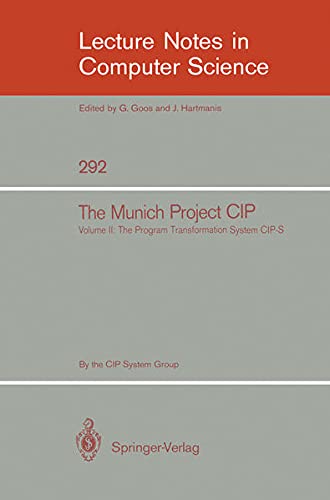
The Munich Project CIP [electronic resource] : Volume II: The Program Transformation System CIP-S / edited by F. L. Bauer, H. Ehler, A. Horsch, B. Möller, H. Partsch, O. Paukner, P. Pepper.
Material type: TextSeries: Lecture Notes in Computer Science ; 292Publisher: Berlin, Heidelberg : Springer Berlin Heidelberg, 1987Description: VIII, 524 p. online resourceContent type:
 - text
- computer
- online resource
- 9783540481799
- Computer science
- Software engineering
- Data structures (Computer science)
- Logic design
- Artificial intelligence
- Computer Science
- Software Engineering
- Programming Techniques
- Programming Languages, Compilers, Interpreters
- Data Structures
- Logics and Meanings of Programs
- Artificial Intelligence (incl. Robotics)
- 005.1 23
- QA76.758
 E-BOOKS
| Home library | Call number | Materials specified | URL | Status | Date due | Barcode | |
|---|---|---|---|---|---|---|---|
| IMSc Library | Link to resource | Available | EBK6350 |
I : Introduction -- II : The transformation calculus -- III : Formal specification -- IV : Formal development of selected system functions -- V : Transformation rules -- VI : A sample instantiation of the system for a concrete language.
This book is the second of two volumes that present the main results which emerged from the project CIP - Computer-Aided, Intuition-Guided Programming - at the Technical University of Munich. Its central theme is program development by transformation, a methodology which is becoming more and more important. Whereas Volume I contains the description and formal specification of a wide spectrum language CIP-L particularly tailored to the needs of transformational programming, Volume II serves a double purpose: First, it describes a system, called CIP-S, that is to assist a programmer in the method of transformational programming. Second, it gives a non-toy example for this very method, since it contains a formal specification of the system core and transformational developments for the more interesting system routines. Based on a formal calculus of program transformations, the informal requirements for the system are stated. Then the system core is formally specified using the algebraic data types and the pre-algorithmic logical constructs of the wide spectrum language CIP-L. It is demonstrated how executable, procedural level programs can be developed from this specification according to formal rules. The extensive collection of these rules is also contained in the book; it can be used as the basis for further developments using this method. Since the system has been designed in such a way that it is parameterized with the concrete programming language to be transformed, the book also contains a guide how to actualize this parameter; the proceeding is exemplified with a small subset of CIP-L.
There are no comments on this title.