
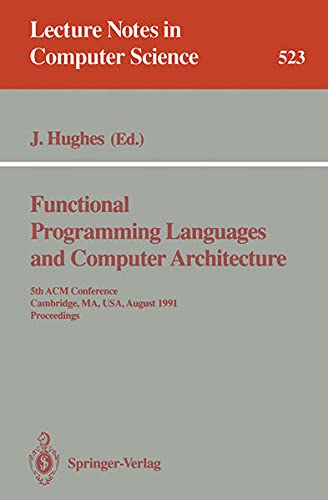
Functional Programming Languages and Computer Architecture [electronic resource] : 5th ACM Conference Cambridge, MA, USA, August 26–30, 1991 Proceedings / edited by John Hughes.
Material type: TextSeries: Lecture Notes in Computer Science ; 523Publisher: Berlin, Heidelberg : Springer Berlin Heidelberg, 1991Description: VIII, 672 p. online resourceContent type:
 - text
- computer
- online resource
- 9783540475996
- 005.13 23
- QA76.7-76.73
- QA76.76.C65
 E-BOOKS
| Home library | Call number | Materials specified | URL | Status | Date due | Barcode | |
|---|---|---|---|---|---|---|---|
| IMSc Library | Link to resource | Available | EBK6123 |
Type classes and overloading resolution via order-sorted unification -- On the complexity of ML typability with overloading -- Coercive type isomorphism -- Compiler-controlled multithreading for lenient parallel languages -- Multi-thread code generation for dataflow architectures from non-strict programs -- GAML: A parallel implementation of lazy ML -- Functional programming with bananas, lenses, envelopes and barbed wire -- A strongly-typed self-applicable partial evaluator -- Automatic online partial evaluation -- Assignments for applicative languages -- Linearity and laziness -- Syntactic detection of single-threading using continuations -- A projection model of types -- What is an efficient implementation of the ?-calculus? -- Outline of a proof theory of parametricity -- Reasoning about simple and exhaustive demand in higher-order lazy languages -- Strictness analysis in logical form -- A note on abstract interpretation of polymorphic functions -- Incremental polymorphism -- Dynamics in ML -- Implementing regular tree expressions -- Efficient type inference for higher-order binding-time analysis -- Finiteness analysis -- For a better support of static data flow -- An architectural technique for cache-level garbage collection -- M-structures: Extending a parallel, non-strict, functional language with state -- List comprehensions in agna, a parallel persistent object system -- Generating efficient code for lazy functional languages -- Making abstract machines less abstract -- Unboxed values as first class citizens in a non-strict functional language.
This book offers a comprehensive view of the best and the latest work in functional programming. It is the proceedings of a major international conference and contains 30 papers selected from 126 submitted. A number of themes emerge. One is a growing interest in types: powerful type systems or type checkers supporting overloading, coercion, dynamic types, and incremental inference; linear types to optimize storage, and polymorphic types to optimize semantic analysis. The hot topic of partial evaluation is well represented: techniques for higher-order binding-time analysis, assuring termination of partial evaluation, and improving the residual programs a partial evaluator generates. The thorny problem of manipulating state in functional languages is addressed: one paper even argues that parallel programs with side-effects can be "more declarative" than purely functional ones. Theoretical work covers a new model of types based on projections, parametricity, a connection between strictness analysis and logic, and a discussion of efficient implementations of the lambda-calculus. The connection with computer architecture and a variety of other topics are also addressed.
There are no comments on this title.