
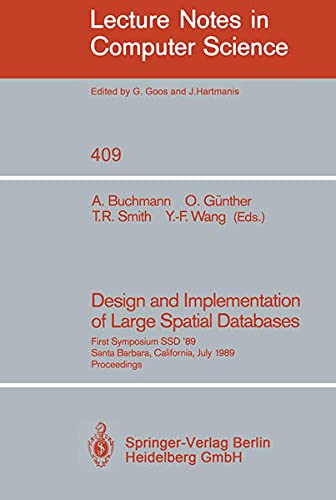
Design and Implementation of Large Spatial Databases [electronic resource] : First Symposium SSD '89 Santa Barbara, California, July 17/18, 1989 Proceedings / edited by Alejandro P. Buchmann, Oliver Günther, Terence R. Smith, Yuan-Fang Wang.
Material type: TextSeries: Lecture Notes in Computer Science ; 409Publisher: Berlin, Heidelberg : Springer Berlin Heidelberg, 1990Description: XII, 372 p. online resourceContent type:
 - text
- computer
- online resource
- 9783540469247
- Computer science
- Data structures (Computer science)
- Computer software
- Database management
- Artificial intelligence
- Computer graphics
- Computer Science
- Database Management
- Data Structures
- Data Storage Representation
- Algorithm Analysis and Problem Complexity
- Artificial Intelligence (incl. Robotics)
- Computer Graphics
- 005.74 23
- QA76.9.D3
 E-BOOKS
| Home library | Call number | Materials specified | URL | Status | Date due | Barcode | |
|---|---|---|---|---|---|---|---|
| IMSc Library | Link to resource | Available | EBK5933 |
7±2 criteria for assessing and comparing spatial data structures -- The fieldtree: A data structure for geographic information systems -- A full resolution elevation representation requiring three bits per pixel -- The DASDBS GEO-Kernel, concepts, experiences, and the second step -- Performance comparison of point and spatial access methods -- Strategies for optimizing the use of redundancy in spatial databases -- Tiling large geographical databases -- Extending a database to support the handling of environmental measurement data -- Thematic map modeling -- Hierarchical spatial data structures -- Distributed quadtree processing -- Node distribution in a PR quadtree -- An object-oriented approach to the design of geographic information systems -- A topological data model for spatial databases -- A well-behaved file structure for the storage of spatial objects -- The design of pictorial databases based upon the theory of symbolic projections -- Reasoning on space with object-centered knowledge representations -- Qualitative spatial reasoning: A semi-quantitative approach using fuzzy logic.
The most recent developments in spatial data management are reported in these proceedings. SSD '89 brought together computer scientists and experts from application areas such as geography, computer vision, robotics, computer-aided manufacturing, and environmental information systems. This proceedings volume includes subjects such as extensible database systems, spatial data structures an index structures, spatial reasoning, geographic information systems, quadtrees, and thematic map modeling.
There are no comments on this title.