
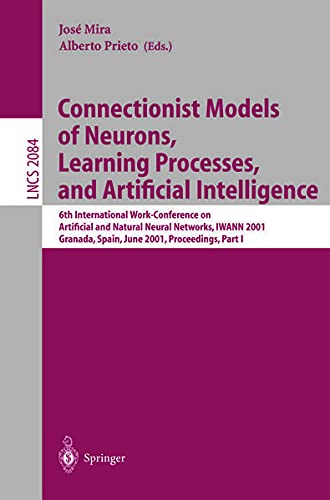
Connectionist Models of Neurons, Learning Processes, and Artificial Intelligence [electronic resource] : 6th International Work-Conference on Artificial and Natural Neural Networks, IWANN 2001 Granada, Spain, June 13–15, 2001 Proceedings, Part 1 / edited by José Mira, Alberto Prieto.
Material type: TextSeries: Lecture Notes in Computer Science ; 2084Publisher: Berlin, Heidelberg : Springer Berlin Heidelberg, 2001Description: XXVIII, 840 p. online resourceContent type:
 - text
- computer
- online resource
- 9783540457206
- 004.0151 23
- QA75.5-76.95
 E-BOOKS
| Home library | Call number | Materials specified | URL | Status | Date due | Barcode | |
|---|---|---|---|---|---|---|---|
| IMSc Library | Link to resource | Available | EBK5537 |
Foundations of Connectionism and Biophysical Models of Neurons -- Structural and Functional Models of Neurons -- Learning and Other Plasticity Phenomena, and Complex Systems Dynamics -- Artificial Intelligence and Cognitive Processes.
Underlying most of the IWANN calls for papers is the aim to reassume some of the motivations of the groundwork stages of biocybernetics and the later bionics formulations and to try to reconsider the present value of two basic questions. The?rstoneis:“Whatdoesneurosciencebringintocomputation(thenew bionics)?” That is to say, how can we seek inspiration in biology? Titles such as “computational intelligence”, “arti?cial neural nets”, “genetic algorithms”, “evolutionary hardware”, “evolutive architectures”, “embryonics”, “sensory n- romorphic systems”, and “emotional robotics” are representatives of the present interest in “biological electronics” (bionics). Thesecondquestionis:“Whatcanreturncomputationtoneuroscience(the new neurocybernetics)?” That is to say, how can mathematics, electronics, c- puter science, and arti?cial intelligence help the neurobiologists to improve their experimental data modeling and to move a step forward towards the understa- ing of the nervous system? Relevant here are the general philosophy of the IWANN conferences, the sustained interdisciplinary approach, and the global strategy, again and again to bring together physiologists and computer experts to consider the common and pertinent questions and the shared methods to answer these questions.
There are no comments on this title.