
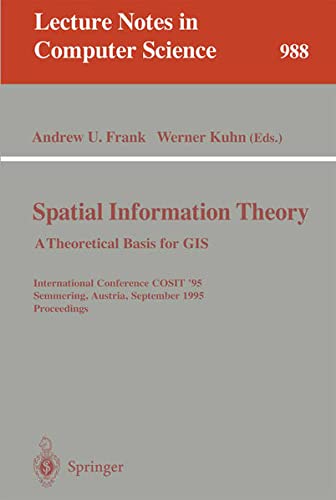
Spatial Information Theory A Theoretical Basis for GIS [electronic resource] : International Conference COSIT '95 Semmering, Austria, September 21–23, 1995 Proceedings / edited by Andrew U. Frank, Werner Kuhn.
Material type: TextSeries: Lecture Notes in Computer Science ; 988Publisher: Berlin, Heidelberg : Springer Berlin Heidelberg, 1995Description: XIV, 578 p. online resourceContent type:
 - text
- computer
- online resource
- 9783540455196
- Computer science
- Database management
- Information storage and retrieval systems
- Artificial intelligence
- Computer graphics
- Optical pattern recognition
- Computer Science
- Artificial Intelligence (incl. Robotics)
- Database Management
- Information Storage and Retrieval
- Computer Graphics
- Data Storage Representation
- Pattern Recognition
- 006.3 23
- Q334-342
- TJ210.2-211.495
 E-BOOKS
| Home library | Call number | Materials specified | URL | Status | Date due | Barcode | |
|---|---|---|---|---|---|---|---|
| IMSc Library | Link to resource | Available | EBK5429 |
Naive Geography -- Qualitative spatial reasoning using algebraic topology -- Proximity operators for qualitative spatial reasoning -- Qualitative distances -- Measuring without measures the ?-calculus -- The Millennium Project: Constructing a dynamic 3+D virtual environment for exploring geographically, temporally and categorically organized historical information -- Providing spatial navigation for the World Wide Web -- Structural analysis of geographic information and GIS operations from a user's perspective -- A loosely coupled interface to an object-oriented geographic database -- Overcoming the knowledge acquisition bottleneck in map generalization: The role of interactive systems and computational intelligence -- Spectral representations of linear features for generalisation -- A triangulated spatial model for cartographic generalisation of areal objects -- Object orientation and location updating during nonvisual navigation: The characteristics and effects of object-versus trajectory-centered processing modes -- Path selection and route preference in human navigation: A progress report -- How spatial information connects visual perception and natural language generation in dynamic environments: Towards a computational model -- On the determination of the optimum path in space -- A unifying framework for multilevel description of spatial data -- Updating visibility information on multiresolut ion terrain models -- Theory for the integration of scale and representation formats: Major concepts and practical implications -- A hierarchical representation of qualitative shape based on connection and convexity -- Representational structures for cognitive space: Trees, ordered trees and semi-lattices -- Reasoning about ordering -- Improving the selection of appropriate spatial interpolation methods -- Spatial pattern and spatial autocorrelation -- Towards a qualitative theory of movement -- Qualitative causal modeling in temporal GIS -- A design support environment for spatio-temporal database applications -- Internal vs. external spatial information and cultural emergence in a self-organizing city -- The social perception of space non-spatial determinants of the use of directionals in Tongan (Polynesia) -- Spatial conceptualizations of social hierarchy in Pohnpei, Micronesia -- On drawing lines on a map -- How significant are cultural differences in spatial cognition? -- A formalism for model-based spatial planning -- Object localization: Selection of optimal reference objects -- Range queries involving spatial relations: A performance analysis -- Evaluating and refining computational models of spatial relations through cross-linguistic human-subjects testing.
This book constitutes the refereed proceedings of the International Conference on Spatial Information Theory, COSIT'95, held near Vienna, Austria, in September 1995. Spatial Information Theory brings together three fields of research of paramount importance for geographic information systems technology, namely spatial reasoning, representation of space, and human understanding of space. The book contains 36 fully revised papers selected from a total of 78 submissions and gives a comprehensive state-of-the-art report on this exciting multidisciplinary - and highly interdisciplinary - area of research and development.
There are no comments on this title.