
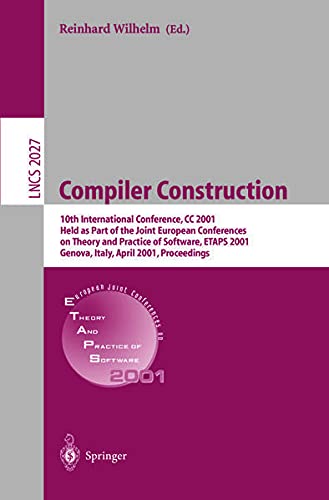
Compiler Construction [electronic resource] : 10th International Conference, CC 2001 Held as Part of the Joint European Conferences on Theory and Practice of Software, ETAPS 2001 Genova, Italy, April 2–6, 2001 Proceedings / edited by Reinhard Wilhelm.
Material type: TextSeries: Lecture Notes in Computer Science ; 2027Publisher: Berlin, Heidelberg : Springer Berlin Heidelberg, 2001Description: XII, 376 p. online resourceContent type:
 - text
- computer
- online resource
- 9783540453062
- 005.13 23
- QA76.7-76.73
- QA76.76.C65
 E-BOOKS
| Home library | Call number | Materials specified | URL | Status | Date due | Barcode | |
|---|---|---|---|---|---|---|---|
| IMSc Library | Link to resource | Available | EBK5299 |
Invited Paper -- Virtual Classes and Their Implementation -- Program Analysis -- Alias Analysis by Means of a Model Checker -- Points-to and Side-Effect Analyses for Programs Built with Precompiled Libraries -- A Novel Probabilistic Data Flow Framework -- Program Transformation -- Imperative Program Transformation by Rewriting -- Compiler Transformation of Pointers to Explicit Array Accesses in DSP Applications -- User-Extensible Simplification—Type-Based Optimizer Generators -- A Practical, Robust Method for Generating Variable Range Tables -- Program Analysis -- Efficient Symbolic Analysis for Optimizing Compilers -- Interprocedural Shape Analysis for Recursive Programs -- Design-Driven Compilation -- Intraprocessor Parallelism -- Software Pipelining of Nested Loops -- A First Step Towards Time Optimal Software Pipelining of Loops with Control Flows -- Comparing Tail Duplication with Compensation Code in Single Path Global Instruction Scheduling -- Register Saturation in Superscalar and VLIW Codes -- Parsing -- Directly-Executable Earley Parsing -- A Bounded Graph-Connect Construction for LR-regular Parsers -- Memory Hierarchy -- Array Unification: A Locality Optimization Technique -- Optimal Live Range Merge for Address Register Allocation in Embedded Programs -- Speculative Prefetching of Induction Pointers -- Constant-Time Root Scanning for Deterministic Garbage Collection -- Profiling -- Goal-Directed Value Profiling -- A Framework for Optimizing Java Using Attributes -- Demos -- SmartTools: A Generator of Interactive Environments Tools -- Visual Patterns in the VLEli System -- The Asf+Sdf Meta-environment: A Component-Based Language Development Environment.
ETAPS 2001 was the fourth instance of the European Joint Conferences on Theory and Practice of Software. ETAPS is an annual federated conference that was established in 1998 by combining a number of existing and new conferences. This year it comprised ve conferences (FOSSACS, FASE, ESOP, CC, TACAS), ten satellite workshops (CMCS, ETI Day, JOSES, LDTA, MMAABS, PFM, RelMiS, UNIGRA, WADT, WTUML), seven invited lectures, a debate, and ten tutorials. The events that comprise ETAPS address various aspects of the system de- lopment process, including speci cation, design, implementation, analysis, and improvement. The languages, methodologies, and tools which support these - tivities are all well within its scope. Di erent blends of theory and practice are represented, with an inclination towards theory with a practical motivation on one hand and soundly-based practice on the other. Many of the issues involved in software design apply to systems in general, including hardware systems, and the emphasis on software is not intended to be exclusive.
There are no comments on this title.