
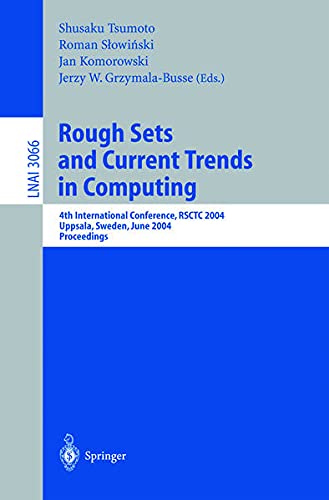
Rough Sets and Current Trends in Computing [electronic resource] : 4th International Conference, RSCTC 2004, Uppsala, Sweden, June 1-5, 2004. Proceedings / edited by Shusaku Tsumoto, Roman Słowiński, Jan Komorowski, Jerzy W. Grzymała-Busse.
Material type: TextSeries: Lecture Notes in Computer Science ; 3066Publisher: Berlin, Heidelberg : Springer Berlin Heidelberg, 2004Description: XX, 860 p. online resourceContent type:
 - text
- computer
- online resource
- 9783540259299
- Computer science
- Database management
- Information systems
- Artificial intelligence
- Computer vision
- Management information systems
- Computer Science
- Artificial Intelligence (incl. Robotics)
- Mathematical Logic and Formal Languages
- Image Processing and Computer Vision
- Database Management
- Information Systems Applications (incl.Internet)
- Business Information Systems
- 006.3 23
- Q334-342
- TJ210.2-211.495
 E-BOOKS
| Home library | Call number | Materials specified | URL | Status | Date due | Barcode | |
|---|---|---|---|---|---|---|---|
| IMSc Library | Link to resource | Available | EBK3195 |
Plenary Papers -- Theory -- Logic and Rough Sets -- Granular Computing -- Rough and Fuzzy Relations -- Foundations of Data Mining -- Incomplete Information Systems -- Interestingness -- Multiagents and Information Systems -- Fuzzy Logic and Modeling -- Rough Classification -- Rough Sets and Probabilities -- Variable Precision Rough Set Model -- Spatial Reasoning -- Reduction -- Rule Induction -- Rough Sets and Neural Network -- Clustering -- Data Mining -- Image and Signal Recognition -- Information Retrieval -- Decision Support -- Adaptive and Opminization Methods -- Bioinformatics -- Medical Applications -- Bibliography Project of International Rough Set Society.
In recent years rough set theory has attracted the attention of many researchers and practitioners all over the world, who have contributed essentially to its development and applications. Weareobservingagrowingresearchinterestinthefoundationsofroughsets, including the various logical, mathematical and philosophical aspects of rough sets. Some relationships have already been established between rough sets and other approaches, and also with a wide range of hybrid systems. As a result, rough sets are linked with decision system modeling and analysis of complex systems, fuzzy sets, neural networks, evolutionary computing, data mining and knowledge discovery, pattern recognition, machine learning, and approximate reasoning. In particular, rough sets are used in probabilistic reasoning, granular computing (including information granule calculi based on rough mereology), intelligent control, intelligent agent modeling, identi?cation of autonomous s- tems, and process speci?cation. Methods based on rough set theory alone or in combination with other - proacheshavebeendiscoveredwith awide rangeofapplicationsinsuchareasas: acoustics, bioinformatics, business and ?nance, chemistry, computer engineering (e.g., data compression, digital image processing, digital signal processing, p- allel and distributed computer systems, sensor fusion, fractal engineering), de- sion analysis and systems, economics, electrical engineering (e.g., control, signal analysis, power systems), environmental studies, informatics, medicine, mole- lar biology, musicology, neurology, robotics, social science, software engineering, spatial visualization, Web engineering, and Web mining.
There are no comments on this title.