
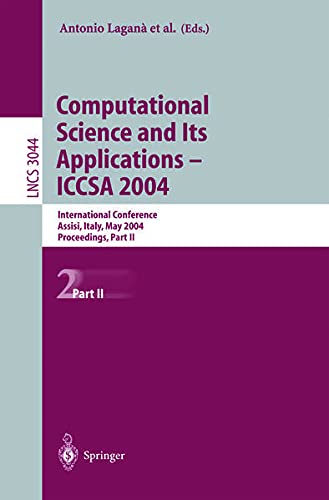
Computational Science and Its Applications – ICCSA 2004 [electronic resource] : International Conference, Assisi, Italy, May 14-17, 2004, Proceedings, Part II / edited by Antonio Laganá, Marina L. Gavrilova, Vipin Kumar, Youngsong Mun, C. J. Kenneth Tan, Osvaldo Gervasi.
Material type: TextSeries: Lecture Notes in Computer Science ; 3044Publisher: Berlin, Heidelberg : Springer Berlin Heidelberg, 2004Description: CVI, 1143 p. online resourceContent type:
 - text
- computer
- online resource
- 9783540247098
- 005.11 23
- QA76.6-76.66
 E-BOOKS
| Home library | Call number | Materials specified | URL | Status | Date due | Barcode | |
|---|---|---|---|---|---|---|---|
| IMSc Library | Link to resource | Available | EBK3148 |
Grid Computing Workshop -- Resource Management and Scheduling Techniques for Cluster and Grid Computing Systems Workshop -- Parallel and Distributed Computing Workshop -- Molecular Processes Simulation Workshop -- Numerical Models in Biomechanics Session -- Scientific Computing Environments (SCE’s) for Imaging in Science Session -- Computer Graphics and Geometric ModelingWorkshop (TSCG 2004) -- Virtual Reality in Scientific Applications and Learning (VRSAL 2004) Workshop -- Web-Based Learning Session -- Matrix Approximations with Applications to Science, Engineering, and Computer Science Workshop -- Spatial Statistics and Geographical Information Systems: Algorithms and Applications.
The natural mission of Computational Science is to tackle all sorts of human problems and to work out intelligent automata aimed at alleviating the b- den of working out suitable tools for solving complex problems. For this reason ComputationalScience,thoughoriginatingfromtheneedtosolvethemostch- lenging problems in science and engineering (computational science is the key player in the ?ght to gain fundamental advances in astronomy, biology, che- stry, environmental science, physics and several other scienti?c and engineering disciplines) is increasingly turning its attention to all ?elds of human activity. In all activities, in fact, intensive computation, information handling, kn- ledge synthesis, the use of ad-hoc devices, etc. increasingly need to be exploited and coordinated regardless of the location of both the users and the (various and heterogeneous) computing platforms. As a result the key to understanding the explosive growth of this discipline lies in two adjectives that more and more appropriately refer to Computational Science and its applications: interoperable and ubiquitous. Numerous examples of ubiquitous and interoperable tools and applicationsaregiveninthepresentfourLNCSvolumescontainingthecontri- tions delivered at the 2004 International Conference on Computational Science and its Applications (ICCSA 2004) held in Assisi, Italy, May 14–17, 2004.
There are no comments on this title.