
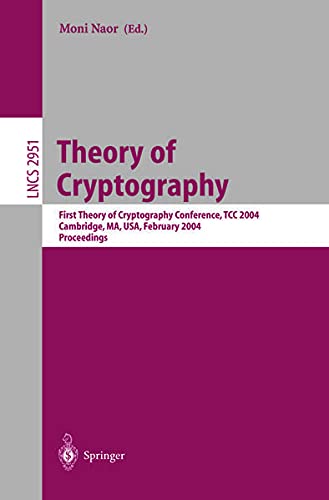
Theory of Cryptography [electronic resource] : First Theory of Cryptography Conference, TCC 2004, Cambridge, MA, USA, February 19-21, 2004. Proceedings / edited by Moni Naor.
Material type: TextSeries: Lecture Notes in Computer Science ; 2951Publisher: Berlin, Heidelberg : Springer Berlin Heidelberg, 2004Description: XII, 532 p. online resourceContent type:
 - text
- computer
- online resource
- 9783540246381
- Computer science
- Operating systems (Computers)
- Data encryption (Computer science)
- Computer software
- Information Systems
- Algorithms
- Computer Science
- Data Encryption
- Operating Systems
- Algorithm Analysis and Problem Complexity
- Computers and Society
- Management of Computing and Information Systems
- Algorithms
- 005.82 23
- QA76.9.A25
 E-BOOKS
| Home library | Call number | Materials specified | URL | Status | Date due | Barcode | |
|---|---|---|---|---|---|---|---|
| IMSc Library | Link to resource | Available | EBK3093 |
Notions of Reducibility between Cryptographic Primitives -- Indifferentiability, Impossibility Results on Reductions, and Applications to the Random Oracle Methodology -- On the Random-Oracle Methodology as Applied to Length-Restricted Signature Schemes -- Universally Composable Commitments Using Random Oracles -- Transformation of Digital Signature Schemes into Designated Confirmer Signature Schemes -- List-Decoding of Linear Functions and Analysis of a Two-Round Zero-Knowledge Argument -- On the Possibility of One-Message Weak Zero-Knowledge -- Soundness of Formal Encryption in the Presence of Active Adversaries -- Rerandomizable and Replayable Adaptive Chosen Ciphertext Attack Secure Cryptosystems -- Alternatives to Non-malleability: Definitions, Constructions, and Applications -- A Note on Constant-Round Zero-Knowledge Proofs for NP -- Lower Bounds for Concurrent Self Composition -- Secret-Key Zero-Knowlegde and Non-interactive Verifiable Exponentiation -- A Quantitative Approach to Reductions in Secure Computation -- Algorithmic Tamper-Proof (ATP) Security: Theoretical Foundations for Security against Hardware Tampering -- Physically Observable Cryptography -- Efficient and Universally Composable Committed Oblivious Transfer and Applications -- A Universally Composable Mix-Net -- A General Composition Theorem for Secure Reactive Systems -- Unfair Noisy Channels and Oblivious Transfer -- Computational Collapse of Quantum State with Application to Oblivious Transfer -- Implementing Oblivious Transfer Using Collection of Dense Trapdoor Permutations -- Composition of Random Systems: When Two Weak Make One Strong -- Simpler Session-Key Generation from Short Random Passwords -- Constant-Round Oblivious Transfer in the Bounded Storage Model -- Hierarchical Threshold Secret Sharing -- On Compressing Encrypted Data without the Encryption Key -- On the Notion of Pseudo-Free Groups.
There are no comments on this title.