
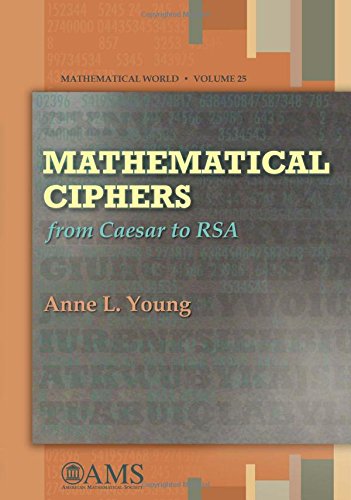
Mathematical ciphers : From Caesar to RSA
Material type: TextLanguage: English Series: Mathematical world ; Vol. 25Publication details: Rhode Island American mathematical society 2006Description: viii, 159p. illISBN:
 - 0821837303 (PB)
- 9780821837306 (PB)
 BOOKS
BOOKS
| Home library | Call number | Materials specified | Status | Date due | Barcode | |
|---|---|---|---|---|---|---|
| IMSc Library | 51:681 YOU (Browse shelf(Opens below)) | Available | 71627 |
Includes index
Includes bibliography (p. 151-152) and references.
1. Introduction
2. Caesar cipher
3. Terminology and results from number theory
4. Modular arithmetic
5. Describing the Caesar cipher mathematically
6. Cryptanalysis for the Caesar cipher
7. Multiplication cipher
8. Cryptanalysis for the multiplication cipher
9. Multiplication-shift cipher
10. Cryptanalysis for the multiplication-shift cipher
11. Non-mathematical substitution ciphers
12. Preparing to generalize
13. Finding inverses modulo n
14. General multiplication-shift cipher
15. Security of the general multiplication-shift cipher
16. Introduction to the exponential cipher
17. Deciphering the exponential cipher
18. Cryptanalysis for the exponential cipher
19. Mathematical basis for the exponential cipher
20. Public key ciphers
21. RSA cipher
22. Signatures
23. Security and implementation of the RSA cipher
24. Computer programs
25. Further reading
26. Answers to selected exercises
A cipher is a scheme for creating coded messages for the secure exchange of information. Throughout history, many different coding schemes have been devised. One of the oldest and simplest mathematical systems was used by Julius Caesar. This is where Mathematical Ciphers begins. Building on that simple system, Young moves on to more complicated schemes, ultimately ending with the RSA cipher, which is used to provide security for the Internet.
This book is structured differently from most mathematics texts. It does not begin with a mathematical topic, but rather with a cipher. The mathematics is developed as it is needed; the applications motivate the mathematics. As is typical in mathematics textbooks, most chapters end with exercises. Many of these problems are similar to solved examples and are designed to assist the reader in mastering the basic material. A few of the exercises are one-of-a-kind, intended to challenge the interested reader.
Implementing encryption schemes is considerably easier with the use of the computer. For all the ciphers introduced in this book, JavaScript programs are available from the Web.
In addition to developing various encryption schemes, this book also introduces the reader to number theory. Here, the study of integers and their properties is placed in the exciting and modern context of cryptology. Mathematical Ciphers can be used as a textbook for an introductory course in mathematics for all majors. The only prerequisite is high school mathematics.
There are no comments on this title.