
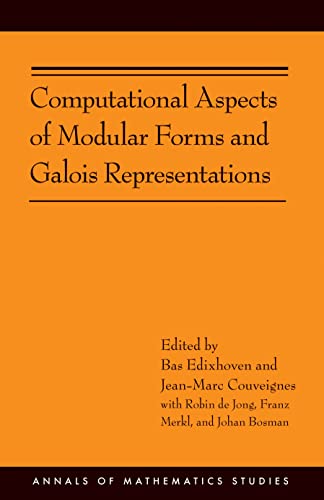
Computational aspects of modular forms and galois representations
Material type: TextLanguage: English Series: Annals of mathematics studies ; 176Publication details: New jersey Princeton university press 2011Description: xii, 425pISBN:
 - 9780691142029 (PB)
 BOOKS
BOOKS
| Home library | Call number | Materials specified | Status | Date due | Barcode | |
|---|---|---|---|---|---|---|
| IMSc Library | 511.2-3(082)“2011” EDI (Browse shelf(Opens below)) | Available | 66408 |
Includes index
Includes bibliography (p. 403-421)
Chapter 1. Introduction, main results, context / Edixhoven, Bas Chapter 2. Modular curves, modular forms, lattices, Galois representations / Edixhoven, Bas Chapter 3. First description of the algorithms / Couveignes, Jean-Marc / Edixhoven, Bas Chapter 4. Short introduction to heights and Arakelov theory / Edixhoven, Bas / de Jong, Robin Chapter 5. Computing complex zeros of polynomials and power series / Couveignes, Jean-Marc Chapter 6. Computations with modular forms and Galois representations / Bosman, Johan Chapter 7. Polynomials for projective representations of level one forms / Bosman, Johan Chapter 8. Description of X1(5l) / Edixhoven, Bas Chapter 9. Applying Arakelov theory / Edixhoven, Bas / de Jong, Robin Chapter 10. An upper bound for Green functions on Riemann surfaces / Merkl, Franz Chapter 11. Bounds for Arakelov invariants of modular curves / Edixhoven, B. / de Jong, R. Chapter 12. Approximating Vf over the complex numbers / Couveignes, Jean-Marc Chapter 13. Computing Vf modulo p / Couveignes, Jean-Marc Chapter 14. Computing the residual Galois representations / Edixhoven, Bas Chapter 15. Computing coefficients of modular forms / Edixhoven, Bas
Modular forms are tremendously important in various areas of mathematics, from number theory and algebraic geometry to combinatorics and lattices. Their Fourier coefficients, with Ramanujan's tau-function as a typical example, have deep arithmetic significance. Prior to this book, the fastest known algorithms for computing these Fourier coefficients took exponential time, except in some special cases. The case of elliptic curves (Schoof's algorithm) was at the birth of elliptic curve cryptography around 1985. This book gives an algorithm for computing coefficients of modular forms of level one in polynomial time. For example, Ramanujan's tau of a prime number P can be computed in time bounded by a fixed power of the logarithm of P. Such fast computation of Fourier coefficients is itself based on the main result of the book: the computation, in polynomial time, of Galois representations over finite fields attached to modular forms by the Langlands program.
There are no comments on this title.