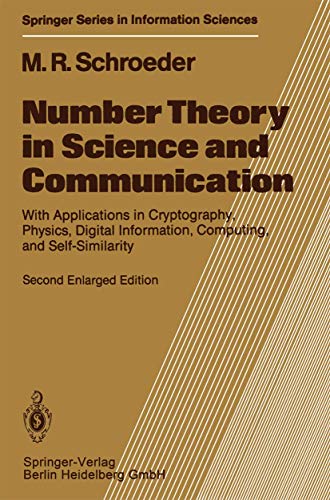
Number theory in science and communication
Material type: TextLanguage: English Publication details: Berlin Springer Berlin Heidelber 1996Description: x, 374p. illISBN:
 - 3540158006 (PB)
 BOOKS
BOOKS
| Home library | Call number | Materials specified | Status | Date due | Barcode | |
|---|---|---|---|---|---|---|
| IMSc Library | 511-7 SCH (Browse shelf(Opens below)) | Available | 21123 |
Includes index
Includes bibliography (p. 353-362) and references
1. Introduction 2. The Natural Numbers 3. Primes 4. The Prime Distribution 5. Fractions: Continued, Egyptian and Farey 6. Linear Congruences 7. Diophantine Equations 8. The Theorems of Fermat, Wilson and Euler 9. Euler Trap Doors and Public-Key Encryption 10. The Divisor Functions 11. The Prime Divisor Functions 12. Certified Signatures 13. Primitive Roots 14. Knapsack Encryption 15. Quadratic Residues 16. The Chinese Remainder Theorem and Simultaneous Congruences 17. Fast Transformation and Kronecker Products 18. Quadratic Congruences 19. Pseudoprimes, Poker and Remote Coin Tossing 20. The Mobius Function and the Mobius Transform 21. Generating Functions and Partitions 22. Cyclotomic Polynomials 23. Linear Systems and Polynomials 24. Polynomial Theory 25. Galois Fields 26. Spectral Properties of Galois Sequences 27. Random Number Generators 28. Waveforms and Radiation Patterns.29. Number Theory, Randomness and "Art" 30. Self-Similarity, Fractals, Deterministic Chaos and a New State of Matter.I. A Few Fundamentals 1. Introduction II. Some Simple Applications III. Congruences and the Like IV. Cryptography and Divisors V. Residues and Diffraction VI. Chinese and Other Fast Algorithms VII. Pseudoprimes, Möbius Transform, and Partitions 20. The Möbius Function and the Möbius Transform VIII. Cyclotomy and Polynomials IX. Galois Fields and More Applications 28. Waveforms and Radiation Patterns 29. Number Theory, Randomness and “Art” X. Self-Similarity, Fractals and Art 30. Self-Similarity, Fractals, Deterministic Chaos and a New State of Matter
An introduction for nonmathematicians. The book stresses intuitive understanding rather than abstract theory. Concepts such as continued fractions, the golden ratio, quadratic residues, trapdoor functions, pseudoprimes and primitive elements are highlighted. Their application to problems in the real world is one of the main themes of the book.
There are no comments on this title.