
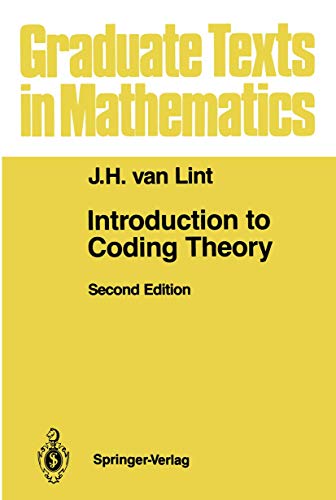
Introduction to coding theory
Material type: TextLanguage: English Series: Graduate texts in mathematics ; 86Publication details: New York Springer-Verlag 1992Edition: 2nd edDescription: xi, 183p. illISBN:
 - 3540548947 (HB)
 BOOKS
BOOKS
| Home library | Call number | Materials specified | Status | Date due | Barcode | |
|---|---|---|---|---|---|---|
| IMSc Library | 519.711 VAN (Browse shelf(Opens below)) | Available | 31887 |
Includes index
Includes bibliography (p. 174-177) and references.
The first edition of this book was conceived in 1981 as an alternative to outdated, oversized, or overly specialized textbooks in this area of discrete mathematics-a field that is still growing in importance as the need for mathematicians and computer scientists in industry continues to grow. The body of the book consists of two parts: a rigorous, mathematically oriented first course in coding theory followed by introductions to special topics. The second edition has been largely expanded and revised. The main editions in the second edition are: (1) a long section on the binary Golay code; (2) a section on Kerdock codes; (3) a treatment of the Van Lint-Wilson bound for the minimum distance of cyclic codes; (4) a section on binary cyclic codes of even length; (5) an introduction to algebraic geometry codes. Eindhoven J. H. VAN LINT November 1991 Preface to the First Edition Coding theory is still a young subject. One can safely say that it was born in 1948. It is not surprising that it has not yet become a fixed topic in the curriculum of most universities. On the other hand, it is obvious that discrete mathematics is rapidly growing in importance. The growing need for mathe maticians and computer scientists in industry will lead to an increase in courses offered in the area of discrete mathematics. One of the most suitable and fascinating is, indeed, coding theory.
There are no comments on this title.